|
New Publication: Materials Horizons | Sibo Chai published Active Curved-Crease Origami Metamaterials for Large Folding Ratio and Tunable Stiffness
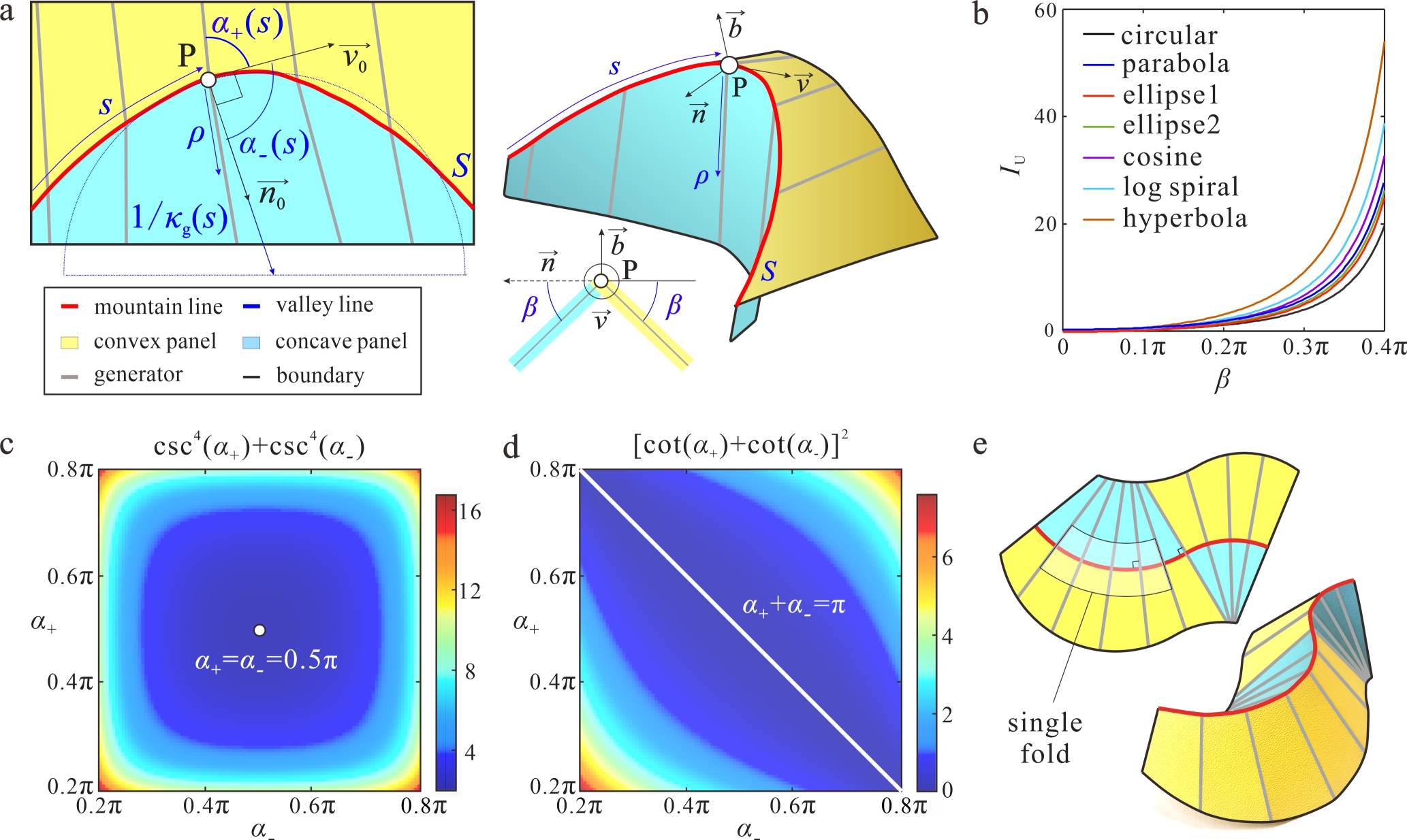
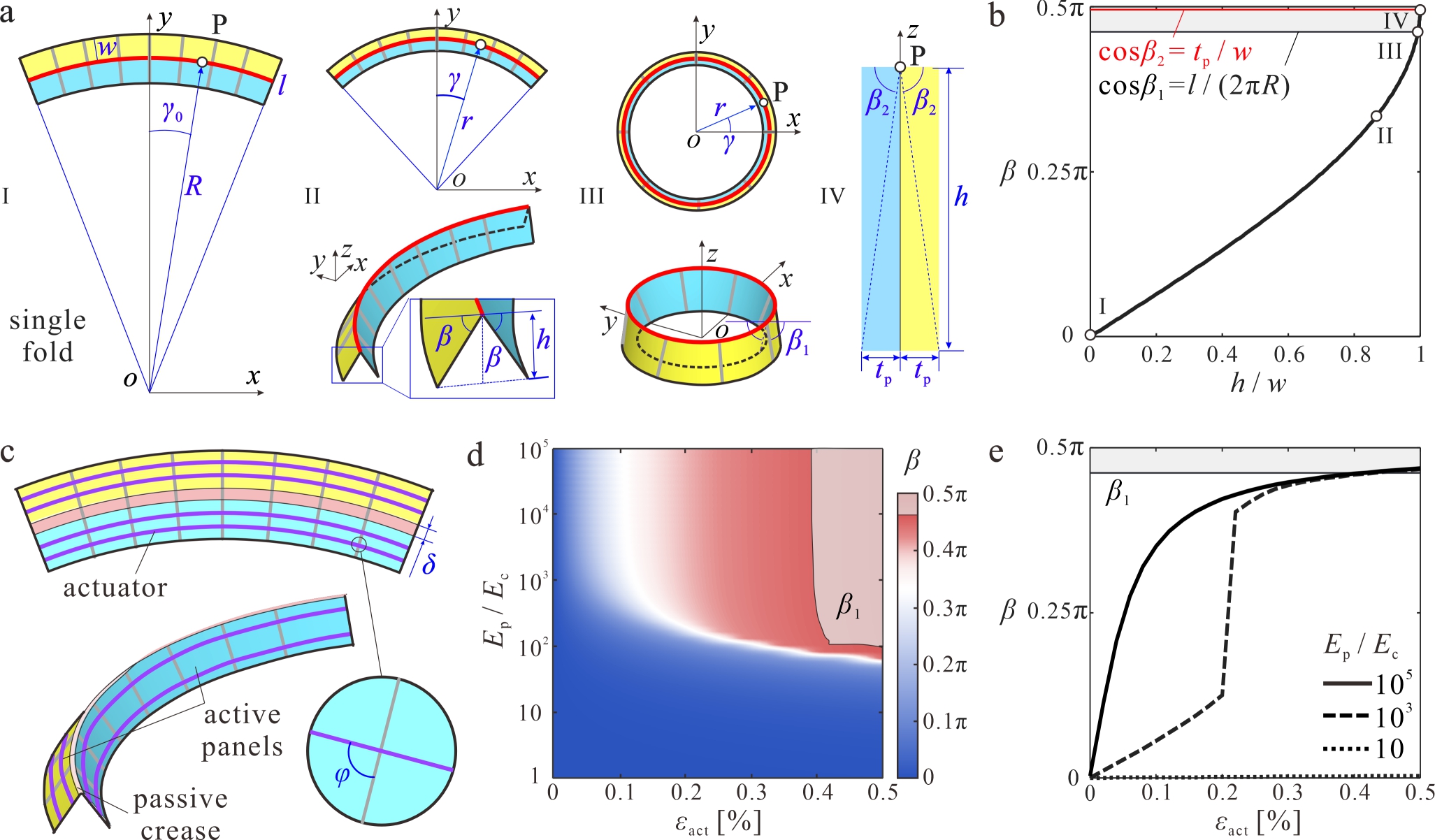
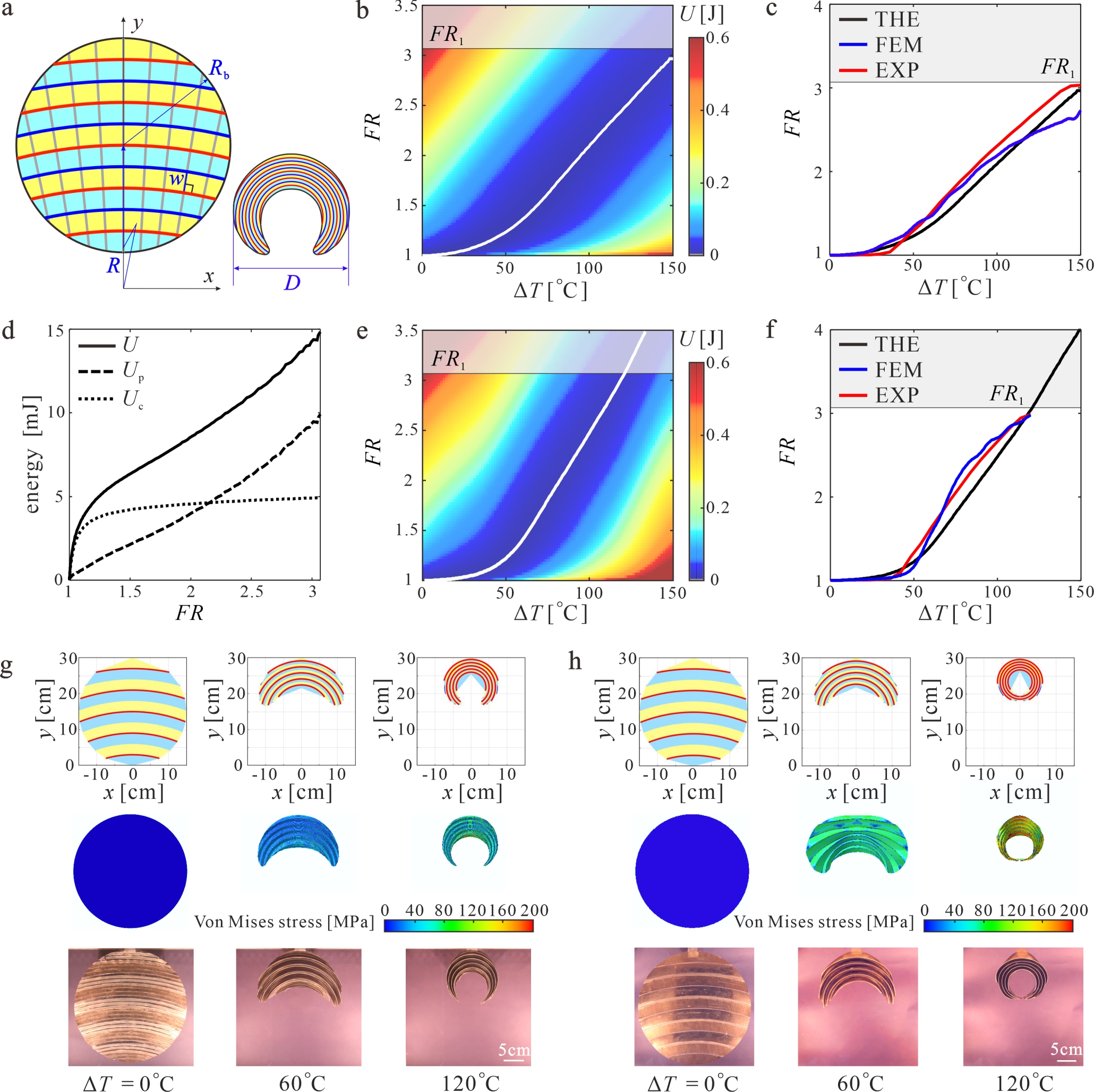
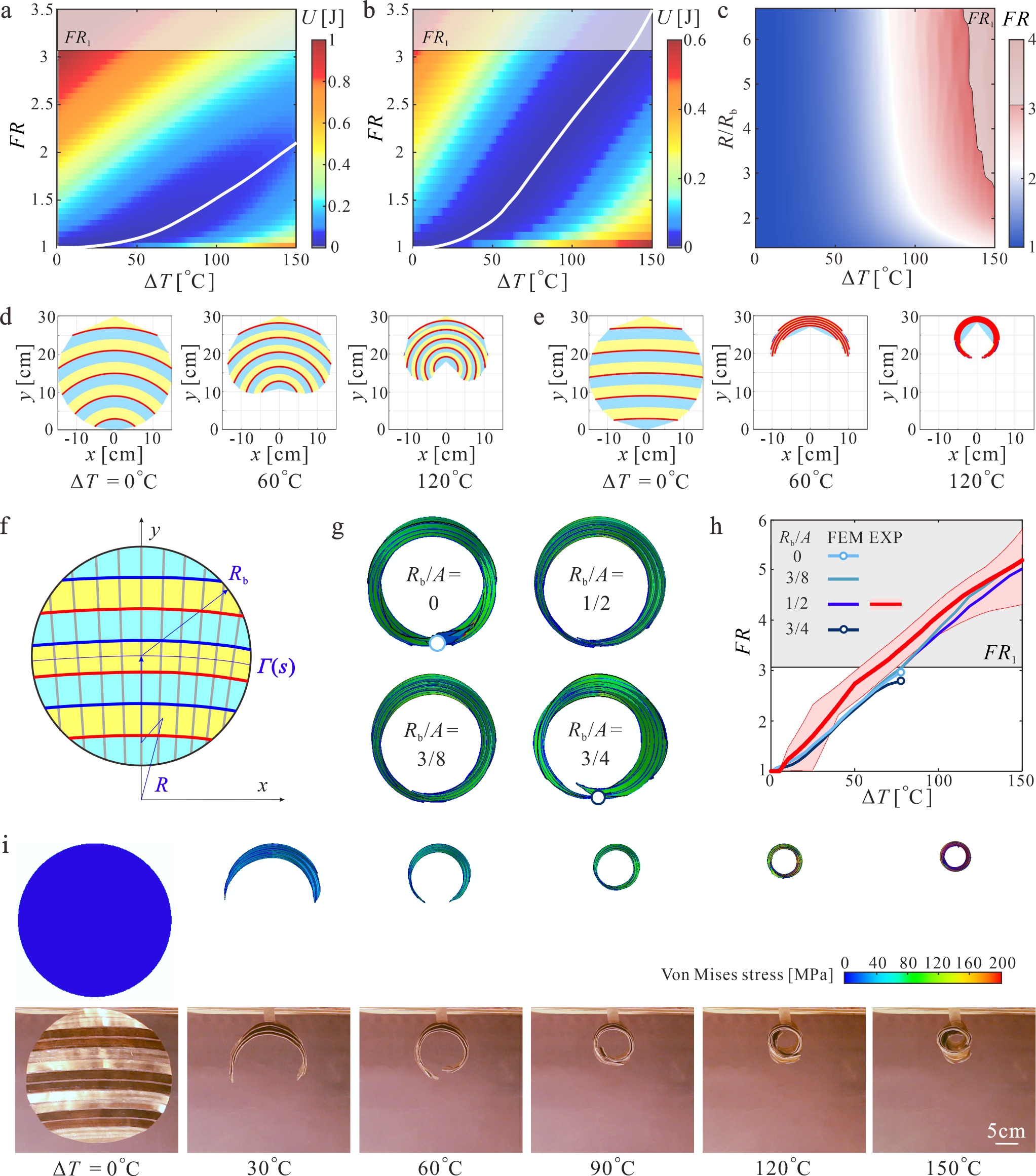
From: Date: 2026-08-06 Active metamaterials are able to change shape autonomously under environmental stimuli and to program and tune a range of physical properties through configuration transformation. Among them, origami metamaterials have attracted extensive attention owing to their capacity for large deformation, richly programmable geometric parameters, and excellent kinematic reconfigurability. In existing active origami, however, stimuli-responsive materials are embedded only within the narrow crease regions, so that both the actuation capability and the mechanical performance are predominantly governed by crease rotation, which considerably limits the achievable folding ratio and the range of property tuning. Curved-crease origami couples crease folding with panel bending and therefore offers a much broader geometric design space than straight-crease origami. Nevertheless, the coordinated design of multiple curved creases and the actuation strategies for active deformation still call for further investigation. Recently, the research team of Prof. Yan Chen and Prof. Jiayao Ma from the School of Mechanical Engineering at Tianjin University, in collaboration with Prof. Zhong You of the University of Oxford, introduced curved-crease origami into active metamaterial design, achieving thermally responsive self-folding with a large folding ratio together with stiffness tunability spanning three orders of magnitude. The related findings were published online on July 21, 2026, in Materials Horizons, under the title "Active curved-crease origami metamaterials for large folding ratio and tunable stiffness". The corresponding authors are Prof. Yan Chen of Tianjin University and Prof. Zhong You of the University of Oxford. The co-first authors are Ph.D. student Sibo Chai and Prof. Jiayao Ma. Master's students Chenhao Zhang and Weizhi Xu also made important contributions to this research. The study was supported by the National Natural Science Foundation of China (Projects 52422502, 524B2048, 52320105005). The team first established a folding kinematic model based on differential geometry for generalized curved-crease origami, derived the elastic strain energy of the coordinated deformation of creases and panels, and analysed how the crease curve equation and the distribution of generators affect the deformation energy of the structure. Using the Cauchy-Schwarz inequality, it was proved that, for a given total crease arc length and rotation angle, keeping the crease curvature constant minimizes the strain energy of both the panels and the creases; this result was verified by comparison among different crease equations. On this basis, it was further proved that the strain energy likewise reaches its minimum when the generators are orthogonal to the crease tangent. These results lead to a design strategy for curved-crease origami in which global strain energy minimization is achieved through constant crease curvature combined with orthogonal generators. Fig. 1 Design strategy and geometric modelling of the minimum-energy curved-crease origami Building on the minimum-energy design, a panel-driven actuation framework for curved-crease origami was established. In the flat state, the panels on either side of the circular arc crease have equal width. During folding, the crease remains a planar curve of uniform curvature, and the two panels always lie on the same inverted conical surface whose curvature varies uniformly. The kinematic relation between the folding angle and the overall height of the structure was then established, and the folding process is bounded by two physical limits: contact between the ends of the strip after a full turn, and complete filling of the gap between adjacent panels by the panel thickness. Once the smart material is integrated into the panels, the folded configuration is uniquely determined by the actuation strain. Further analysis shows that the modulus ratio between panels and creases directly governs the active folding response: at a low modulus ratio, deformation is dominated by the creases and the panels are difficult to actuate; at an intermediate modulus ratio, the structure exhibits snap-through behaviour at a critical actuation strain; at a high modulus ratio, deformation is dominated by the panels and the structure folds smoothly over a large range until it wraps a full turn and reaches the first physical limit. Accordingly, high-modulus thermally responsive bimetallic strips were selected as the active panels and low-modulus hyperelastic silicone as the passive creases, and a model of the thermally responsive actuation mechanism of the bimetallic strip was established. Fig. 2 Panel-driven actuation strategy for the minimum-energy curved-crease origami The minimum-energy design and the panel-driven actuation strategy were then extended to multiple curved creases, yielding a circular sheet formed by a series of alternating mountain and valley circular arc creases. The pattern is defined by a circular outer boundary together with a set of concentric arc creases, and the generators of all panels remain orthogonal to the crease tangents, thereby ensuring geometric compatibility under panel-driven actuation and adherence to the minimum-energy mode throughout. Theoretical predictions, numerical simulations, and experiments agree closely, showing that the circular sheet self-folds from a flat configuration into a coordinated and compact wrapped cylindrical shape as the temperature rises. The analysis also reveals that reducing the number of actuating strips on the panels enhances the active deformation capability and yields a larger folding ratio, although the symmetry of the structure always imposes a geometric interference limit at one full turn. Fig. 3 Thermally responsive wrapped self-folding of the circular sheet To break through the single-turn limit and further increase the folding ratio, a systematic parametric analysis of the crease curvature was carried out. For circular sheets of uniform curvature, a smaller crease curvature gives a more compact folded state. Euler spiral creases, whose curvature varies linearly with arc length, were then introduced. The analysis shows that within a family of spirals sharing the same endpoint curvatures and total rotation angle, this crease likewise possesses the minimum strain energy. Comparison among circular sheets with different degrees of spiralling reveals that too small a curvature gradient reproduces the geometric interference of the uniform-curvature model, whereas too large a gradient causes side-wall contact because the deformation of the panels on the two sides differs excessively. Selecting an appropriate spiral curvature gradient therefore allows the panels on the two sides to become offset after one complete turn, leaving room for subsequent turns, so that the structure completes more than two turns of compact wrapping and attains an area folding ratio of up to 19.1. Fig. 4 Crease curvature programming and multi-turn wrapped self-folding of the circular sheet
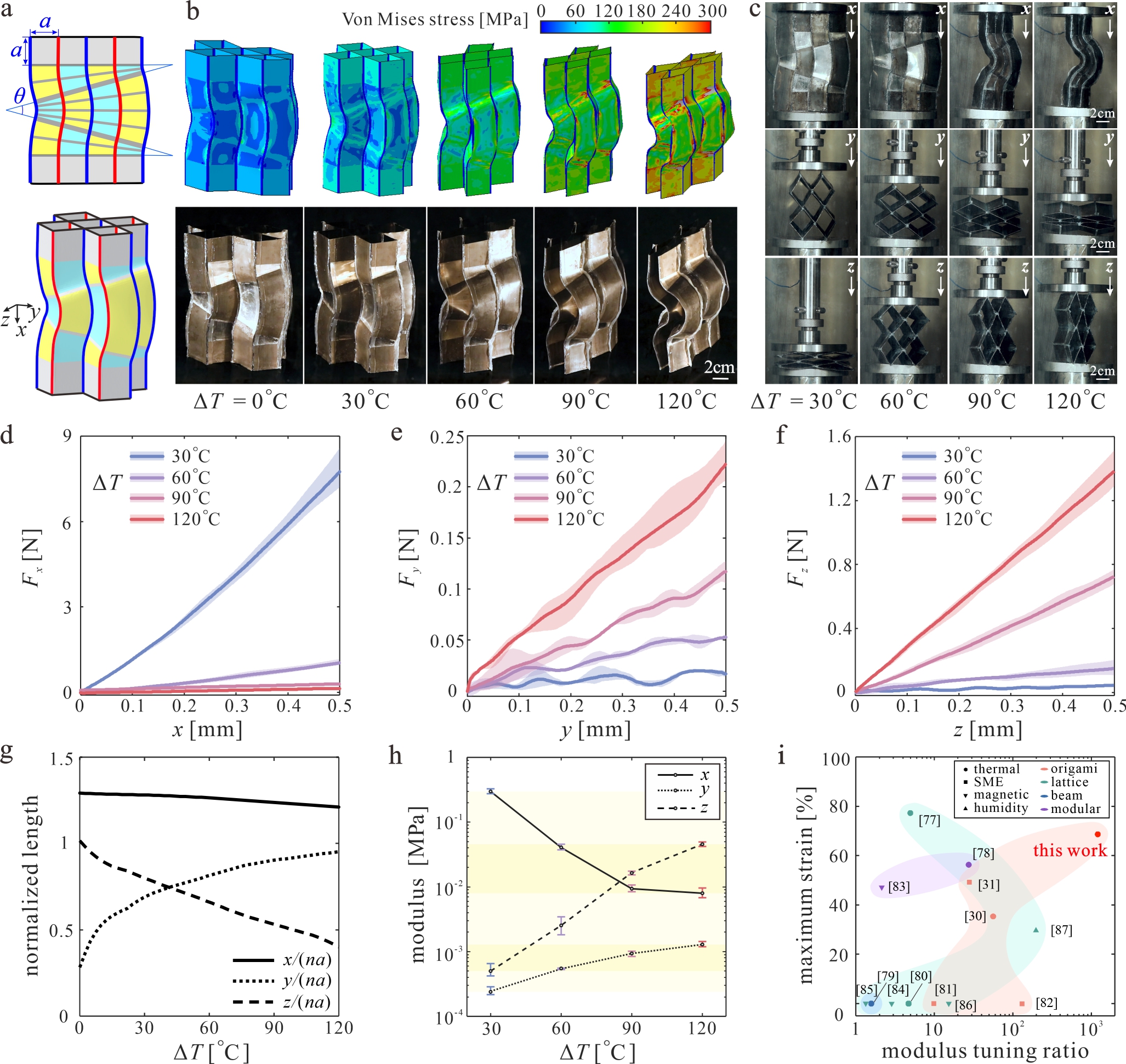
The minimum-energy curved-crease origami was further extended to a multilayer metamaterial design, in which the creases are formed by multiple segments of alternately tangent circular arcs connected by straight segments on both sides. Within each layer the curved creases retain a concentric arrangement, and adjacent layers are assembled mountain crease to mountain crease, thereby realizing three-dimensional extension. Under thermal loading, the metamaterial exhibits pronounced anisotropic large deformation along all three orthogonal directions. Thermomechanical coupling tests were then conducted at constant temperatures. The results show that, as the configuration transforms with temperature, the metamaterial undergoes a continuous mode transition under compression: from a soft mode dominated by crease folding to a load-bearing mode in which crease folding and panel bending act together, giving rise to a continuous and wide-ranging variation of the effective modulus with temperature. The tunable ranges along the three orthogonal directions overlap one another, and the dual control of compression direction and temperature ultimately delivers a tunable modulus spanning three orders of magnitude. Compared with existing studies on stiffness tuning in active metamaterials, the curved-crease origami metamaterial retains a relatively high active deformation strain while achieving the widest modulus tuning range reported to date. Fig. 5 Thermally responsive large deformation and modulus tuning of the curved-crease origami metamaterial
In summary, guided by the principle of minimum deformation energy, this work proposes a series of design strategies for active curved-crease origami metamaterials, establishes a panel-driven actuation framework for the coordinated deformation of multiple curved creases, and realizes wrapped self-folding with a large folding ratio together with stiffness tuning across three orders of magnitude. The study establishes a systematic design methodology and actuation theory for active curved-crease origami metamaterials, offering new opportunities for deployable aerospace structures, medical devices, and soft robotics.
Sibo Chai#, Jiayao Ma#, Chenhao Zhang, Weizhi Xu, Yan Chen*, Zhong You*. Active curved-crease origami metamaterials for large folding ratio and tunable stiffness, Materials Horizons, 2026. |